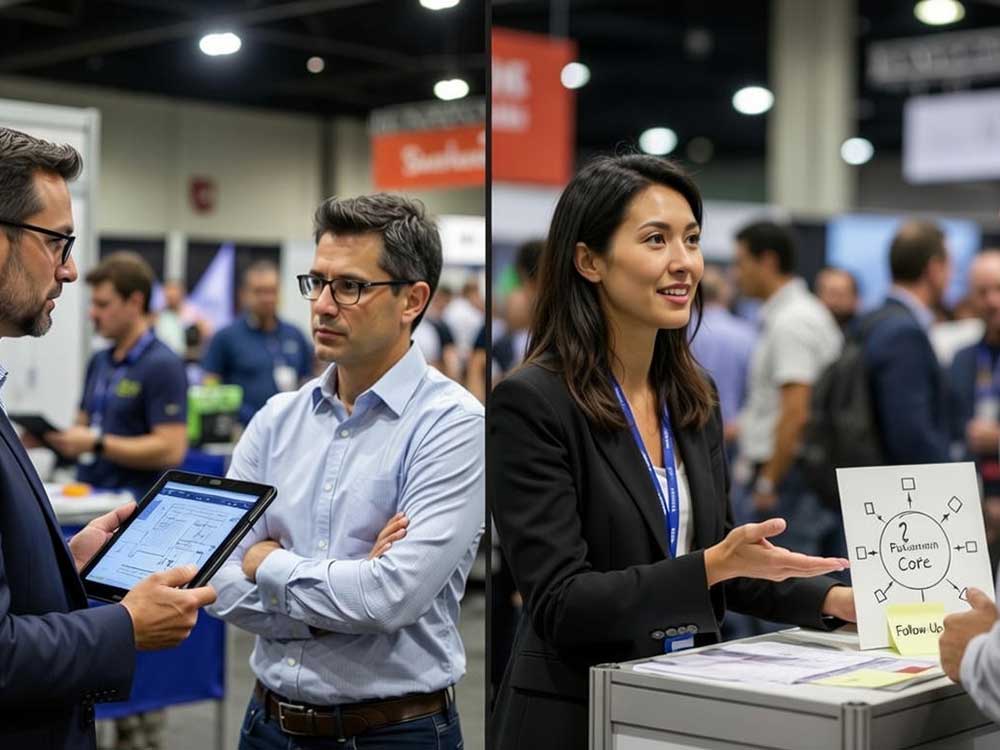
If your company just invested $150,000 in a premium booth at the industry’s biggest trade show. The graphics are stunning, the products are revolutionary, and your leadership team has cleared their calendars to attend. Opening day arrives, and within the first hour, you realize something’s terribly wrong. Your exhibition staff is disengaged, fumbling product demonstrations, and one crew member is scrolling through their phone while a potential million-dollar client walks past your booth unacknowledged.
That sinking feeling in your stomach? That’s the sound of your investment evaporating in real-time.
Here’s what most businesses don’t realize until it’s too late: a bad hire at a trade show doesn’t just cost you money—it actively sabotages everything you’ve worked to build. While you can replace faulty technology or redesign underwhelming booth graphics between events, the damage from poor staffing happens instantly and spreads like wildfire through your target market. The worst part? You often don’t discover the full extent of the damage until months later when expected leads never materialize and your competitors mysteriously seem to have connected with all the right people.
The hidden truth about exhibition staffing is that most companies treat it as an afterthought, a budget line item to minimize rather than a strategic investment to maximize. They hire whoever’s available, whoever’s cheapest, or worse—they pull employees from departments with zero exhibition experience and expect magic to happen. This approach doesn’t just fail to deliver results; it creates a cascading series of problems that can haunt your business for years.
Let’s talk about what’s really at stake when you cut corners on exhibition crew recruitment, and more importantly, why investing in professional staffing might be the smartest financial decision your marketing department makes all year.
The True Cost of a Bad Trade Show Hire Goes Far Beyond the Paycheck
When calculating the cost of bad trade show hire, most financial officers look at the obvious numbers: wasted wages, perhaps some training time, maybe the cost of finding a replacement for the next event. But this surface-level accounting misses the iceberg lurking beneath the waterline.
Consider what happens when your exhibition staff underperforms. A major industry trade show might attract 50,000 attendees over three days. Your booth position and marketing efforts might drive 500 qualified prospects to your space. With proper staffing, your conversion rate from booth visitor to qualified lead could hit 40%—that’s 200 solid opportunities. But deploy the wrong crew, and that conversion rate plummets to 10% or lower. You’ve just lost 150 potential clients who may never give you a second chance.
Now, let’s attach real numbers to those lost opportunities. If your average customer lifetime value is $50,000, and even just 10% of those missed leads would have eventually converted to customers, you’ve just watched $750,000 in potential revenue walk away. Suddenly, that $3,000 you saved by hiring discount exhibition staff looks catastrophically expensive.
But the financial bleeding doesn’t stop there. Poor exhibition staff create ripple effects that compound over time:
Brand reputation damage happens faster at trade shows than almost any other marketing channel. Industry events are concentrated environments where news travels at lightning speed. One rude interaction, one incompetent product demonstration, one unprofessional appearance gets discussed at the hotel bar that evening, shared on LinkedIn by the weekend, and remembered at the executive level when purchasing decisions are made six months later. Your competitors don’t even need to outperform you—they just need to appear minimally competent while your team struggles, and suddenly they’re the “safer choice.”
The psychological principle at work here is powerful: people remember negative experiences far more vividly than positive ones. A prospect might forget a great booth visit, but they’ll remember—and tell colleagues about—the exhibition staff member who couldn’t answer basic questions about your product or, worse, provided incorrect information that wasted their time.
Opportunity cost represents another hidden expense category. Every moment your poorly trained crew spends with unqualified visitors or handles situations inefficiently is time not spent with high-value prospects. Professional exhibition crews excel at rapid qualification—they can identify decision-makers within 30 seconds of conversation and either engage deeply or graciously redirect attention to more promising opportunities. Amateur staff waste equal time on everyone, which sounds democratic but is actually a strategic disaster. When your CEO notices that the VP of a Fortune 500 company left your booth after a three-minute conversation with zero follow-up captured, the questions about your staffing decisions become very uncomfortable.
The Anatomy of Exhibition Crew Failure: Where Things Go Wrong
Understanding the cost of bad trade show hire requires examining the specific failure modes that plague underqualified exhibition crews. These aren’t hypothetical scenarios—they’re patterns that repeat across thousands of trade shows annually, costing businesses hundreds of millions in aggregate losses.
The energy mismatch is often the first visible problem. Trade shows are physically and mentally exhausting. Days start early with setup, continue through eight-hour shifts of constant engagement, and often extend into evening networking events. Inexperienced crew members simply don’t understand the endurance required. By day two, they’re visibly exhausted, less enthusiastic, and counting the minutes until they can leave. Professional exhibition staff, conversely, train for this exact scenario—they manage energy levels, maintain enthusiasm through proven techniques, and understand that their peak performance needs to extend across the entire event duration.
This isn’t about hiring naturally energetic people; it’s about recruiting individuals with specific experience in sustained professional engagement. There’s a massive difference between someone who’s great at their office job and someone who can maintain executive-level presence while standing for eight hours, engaging with hundreds of strangers, many of whom are actively skeptical or rushed.
Product knowledge gaps create another critical failure point. Your internal employees might know your products inside and out, but do they know how to communicate that knowledge to a stranger in 90 seconds? Can they adjust their pitch based on rapid-fire verbal and nonverbal cues? Do they understand which technical details matter to engineers versus purchasing managers versus C-level executives? Professional exhibition crews don’t necessarily start with deep product knowledge, but they excel at the rapid acquisition and situational deployment of information. They’re trained to learn your key value propositions, understand your competitive differentiators, and communicate both with clarity and precision under pressure.
Amateur staff often make the fatal mistake of either oversimplifying to the point of meaninglessness or overwhelming prospects with unnecessary technical detail. Both approaches destroy engagement. The sweet spot—delivering exactly the right information at the right depth to match the prospect’s role and interest level—requires specific training and experience that most employees simply don’t possess.
Lead capture failures represent perhaps the most measurable cost of poor exhibition staffing. You’ve invested significantly in bringing prospects to your booth, but what happens to that investment if contact information is captured incorrectly, qualification data is incomplete, or follow-up commitments aren’t properly documented? Professional crews understand that lead capture isn’t just about scanning a badge—it’s about gathering actionable intelligence that your sales team can use to craft personalized outreach. They know which qualifying questions to ask, how to gather information without making the interaction feel like an interrogation, and how to properly document next steps.
Amateur staff often treat lead capture as a checkbox exercise, resulting in a post-show list of names with minimal context. Your sales team then faces the impossible task of cold-calling “warm” leads who they know nothing about, dramatically reducing conversion rates and wasting the entire point of exhibition marketing.
The ROI Equation: Why Professional Exhibition Crew Recruitment Pays for Itself
When we examine the ROI of trade show staff through a rigorous financial lens, the case for professional recruitment becomes overwhelming. Yet many businesses continue to make decisions based on instinct rather than data, often because they’ve never calculated what effective exhibition staffing actually delivers.
Let’s construct a realistic scenario using industry-average numbers. You’re attending a major industry trade show with the following investment:
- Booth space and design: $120,000
- Travel and accommodations: $15,000
- Marketing and promotional materials: $25,000
- Products and demos: $20,000
- Exhibition staff (in-house, pulled from operations): $8,000
- Total investment: $188,000
With mediocre staffing, you might generate 75 qualified leads, of which 8% eventually convert to customers over the following year. If your average sale is $75,000, you’ve generated $450,000 in new revenue from an investment of $188,000—not terrible at first glance. Many companies look at this outcome and feel satisfied.
Now, let’s run the same scenario with professional exhibition crew recruitment:
- Booth space and design: $120,000
- Travel and accommodations: $15,000
- Marketing and promotional materials: $25,000
- Products and demos: $20,000
- Professional exhibition crew: $18,000
- Total investment: $198,000
The professional crew costs $10,000 more, increasing your overall investment by about 5%. However, professional staffing delivers dramatically different results across multiple metrics:
- Qualified leads increase to 180 (professional crews excel at attraction and qualification)
- Conversion rate increases to 12% (better qualification and information capture enables more effective follow-up)
- Average sale increases slightly to $80,000 (professional crews engage more senior decision-makers and position your solution more effectively)
The result? You’ve generated $1,728,000 in new revenue from an investment of $198,000. The professional crew didn’t just pay for itself—it transformed the entire event’s economics. Your return on investment jumped from 2.4x to 8.7x, all for a 5% increase in total budget.
This isn’t theoretical math. These multiplier effects appear consistently across properly staffed exhibitions because professional crews optimize the entire conversion funnel simultaneously. They attract more traffic through superior engagement techniques, qualify more effectively to focus resources on genuine prospects, communicate value propositions more persuasively, and capture information that enables dramatically higher post-show conversion rates.
The Intangible Returns: Brand Equity and Market Positioning
Beyond direct revenue impact, professional exhibition crew recruitment delivers substantial but often overlooked benefits in brand perception and competitive positioning. These intangible returns don’t appear on quarterly financial statements but compound over time to create durable competitive advantages.
Trade shows serve as one of the few environments where your brand, your competitors’ brands, and your target market coexist in the same physical space simultaneously. This creates a real-time comparison environment unlike any other marketing channel. Prospects don’t just evaluate your booth in isolation—they evaluate it relative to every other booth they visit that day. Your exhibition crew becomes the human embodiment of your brand promise. Are they professional, knowledgeable, and genuinely helpful? Or are they disengaged, confused, and obviously counting the hours until their shift ends?
This comparison isn’t subtle. Industry buyers attend multiple trade shows annually and develop refined instincts about which companies have their act together. Professional exhibition crews signal organizational competence, attention to detail, and customer service orientation before a single word about your product is spoken. Amateur crews signal the opposite, creating unconscious skepticism that your sales team must overcome in every subsequent interaction.
The market positioning implications extend into network effects. Professional exhibition staff excel at facilitating introductions, connecting prospects with the right people in your organization, and creating memorable experiences that people discuss afterward. They transform your booth from a transaction point into a networking hub, attracting additional foot traffic through organic word-of-mouth during the event itself.
Consider the business development implications: when your exhibition crew makes a genuinely great impression on a prospect, that prospect often becomes an informal ambassador for your brand, mentioning you positively in conversations with peers and potentially even making introductions. When your crew delivers a poor experience, the opposite occurs—they become a cautionary tale. These network effects multiply the impact of your staffing decisions far beyond the direct interactions that occur at your booth.
Risk Mitigation: What Professional Recruitment Prevents
Understanding the cost of bad trade show hire requires examining not just what you gain from great staffing but what you avoid. Professional exhibition crew recruitment functions as risk mitigation, protecting your investment against multiple failure modes that amateur approaches invite.
Staffing continuity problems plague companies that rely on internal employees or hastily recruited temporary workers. Someone gets sick, faces an unexpected family emergency, or simply doesn’t show up. Professional recruitment agencies maintain deep benches of qualified candidates and can provide last-minute replacements who are briefed, trained, and ready to perform. They also conduct background checks, verify references, and assess reliability in ways that individual companies typically can’t or don’t prioritize.
Compliance and legal exposure represents another risk category. Professional exhibition crews understand regulations around data collection, privacy, appropriate workplace behavior, and industry-specific compliance requirements. They’re trained to handle difficult situations diplomatically and know when to escalate issues to management. Amateur staff might inadvertently create legal exposure through inappropriate comments, aggressive sales tactics, or mishandling of confidential information shared by prospects.
Crisis management capacity makes an enormous difference when problems arise. Equipment malfunctions, product demonstrations go wrong, or difficult visitors create scenes. Professional exhibition crews have encountered these scenarios before and know how to maintain composure, minimize disruption, and protect your brand image even when things don’t go according to plan. Inexperienced staff often freeze, overreact, or make situations worse through poor judgment under pressure.
Making the Strategic Shift: Viewing Exhibition Staff as Investment, Not Expense
The fundamental shift required for optimal ROI of trade show staff is psychological: exhibition crew must be repositioned from an expense to be minimized to an investment to be optimized. This reframing changes decision-making across your entire exhibition marketing strategy.
When you view staffing as an expense, you naturally seek the cheapest viable option. When you view it as an investment, you seek the highest return option. These optimization targets produce completely different outcomes. The cheapest exhibition crew might cost $8,000 but generate $450,000 in revenue. The best exhibition crew might cost $20,000 but generate $2,000,000 in revenue. Which is actually more expensive?
Professional exhibition crew recruitment agencies understand this investment framework and structure their services accordingly. They don’t simply provide bodies to fill space—they provide strategic partners who understand your business objectives, represent your brand authentically, and execute sophisticated engagement strategies that maximize every dollar you’ve invested in exhibition marketing.
These agencies recruit specifically for exhibition skills: comfort with extended public engagement, rapid relationship building, situational communication flexibility, high-pressure composure, and consistent energy management. They train their crews across multiple client engagements, meaning the team representing your company at this trade show brings accumulated wisdom from dozens of previous events. They understand what works, what doesn’t, and how to adapt strategies based on real-time feedback from booth traffic patterns and engagement quality.
The Competitive Reality: Your Rivals Are Already Doing This
Here’s the uncomfortable truth: while you’re debating whether professional exhibition crew recruitment is worth the investment, your most successful competitors have already made this shift. They’re not just outperforming you at trade shows—they’re leveraging that performance into sustained competitive advantages that compound over time.
The best-performing companies in most industries treat exhibition marketing as a core competency, not an afterthought. They maintain relationships with top-tier recruitment agencies, book their preferred crew members months in advance, and invest in pre-show briefings and training that ensure everyone is aligned on strategy, messaging, and execution. They measure results obsessively, tracking not just lead volume but lead quality, conversion rates, and ultimately revenue generated per exhibition dollar invested.
This creates a widening gap between companies that take exhibition staffing seriously and those that don’t. The gap isn’t just about one trade show’s performance—it’s about cumulative brand perception, relationship development, and market positioning over years. Companies with consistently professional exhibition presence become known as category leaders. Companies with inconsistent or mediocre exhibition presence fade into the background, regardless of how good their actual products or services might be.
The Decision That Determines Your Exhibition Success
The cost of bad trade show hire extends far beyond the immediate financial waste of paying for underperforming staff. It encompasses lost revenue opportunities, damaged brand reputation, weakened market positioning, and competitive disadvantages that persist long after each event concludes. When you factor in all these elements, the true cost of poor exhibition staffing often exceeds the entire rest of your trade show investment combined.
Conversely, professional exhibition crew recruitment delivers returns across multiple dimensions simultaneously: more leads, better lead quality, higher conversion rates, enhanced brand perception, stronger market positioning, and risk mitigation that protects your investment. The financial case is overwhelming, but it requires shifting perspective from viewing exhibition staff as an expense line to minimize to recognizing them as the leverage point that determines whether your entire exhibition marketing investment succeeds or fails.
Your booth design, promotional materials, and products are all important. But none of them engage with prospects, build relationships, or close opportunities. Your exhibition crew does all of that, making them either your greatest asset or your most expensive liability. The difference comes down to a single decision: invest in professional recruitment or accept the predictable consequences of treating this critical role as an afterthought.
The companies dominating your industry at trade shows have already made their choice. The question is: what choice will you make for your next event?